
At a glance
- Only campground
- Cinnamon Bay Beach & Campground, inside the national park
- U.S. National Park Service · verified
- Minimum stay
- 2 nights; 7 over Christmas, New Year, Presidents and Easter weeks
- Cinnamon Bay Beach & Campground · verified
- Season 2026–27
- Reopened Nov 1, 2026 per a local closings list; the camp publishes no dates
- ExploreSTJ · verified
Short answer
Yes, you can camp on St. John, but only in one place: Cinnamon Bay Beach & Campground on the North Shore, the only spot in the national park where camping is allowed. It has eco-tents, concrete cottages and bare sites a few steps from one of the island’s best beaches. A local closings list gave a November 1, 2026 reopening for the season; the camp’s own site publishes no season dates, so check when you book.
Book on the campground’s own website, cinnamonbayvi.com, 11 months ahead. Expect fans but no A/C anywhere in camp, bugs at dusk, unlit paths and power cuts that can last a day. If you want the outdoors with more comfort, Concordia Eco Resort near Salt Pond has eco cabins and open-air cabanas next to air-conditioned studios.
Cinnamon Bay campground
The campground sits behind Cinnamon Bay beach, about 4 miles from Cruz Bay on North Shore Road. A park concessioner runs it, so you book with the camp, not the park service: the park’s camping page says camping is by reservation at Cinnamon Bay Beach and Campground only.

| Stay | What you get | Sleeps |
|---|---|---|
| Eco-tent | Queen bed, ceiling fan, one outlet, cooking kit with a propane stove | 2; family and group tents with bunks sleep 4; oceanside tents cost more |
| Cottage | Concrete unit with queen bed, sofa bed with trundle, mini-fridge, cooking kit; upper terrace units add a propane grill | 4 |
| Bare site | Wood platform with rain cover, picnic table and charcoal grill; no bedding, cookware, towels or power | 2 adults and 2 kids |
Extras you reserve ahead: tent rental $20, cooking kit $30, cooler $20. Nightly rates show only in the booking engine; we don’t quote old ones.
Booking rules. Online booking opens 11 months before arrival, and winter and holiday weeks go first. The minimum is 2 nights, and 7 over Christmas and New Year’s, Presidents’ Week and Easter Week. You pay a 50% deposit, the rest 30 days before arrival. Cancel more than 30 days out and you get it back less 10%; inside 30 days you lose the whole deposit, and cancellations must be in writing. Check-in is 4 p.m., check-out 10 a.m.
Park limits. The park caps stays at 14 nights in a row within any 3 months and 30 days a year; the compendium adds a 14-day limit from December 1 to April 15 and bans generators in the campground.
On site. The camp has a store with ice, charcoal, reef-safe sunscreen and bug spray, and the Rain Tree Cafe serves breakfast and dinner, with lunch from a food truck. There are kayak, paddleboard and snorkel rentals on the beach. Free things to do: the 0.5-mile Cinnamon Bay Nature Loop through the sugar-factory ruins, the park’s ranger programs, and Friends of the Park’s free learn-to-swim mornings on the beach.
Shop before you drive out
The camp store covers basics only. Do your groceries in Cruz Bay before the drive (see Groceries and provisioning), and bring a cooler, or rent one. A safari taxi from the ferry costs $14 for one rider or $11 each for two or more, so you can camp without a car.
Cinnamon Bay Beach & Campground
CampgroundNorth Shore
Eco-tents, cottages and bare sites behind Cinnamon Bay beach, the only lodging inside the national park.
- Camping
- Restrooms
- Showers
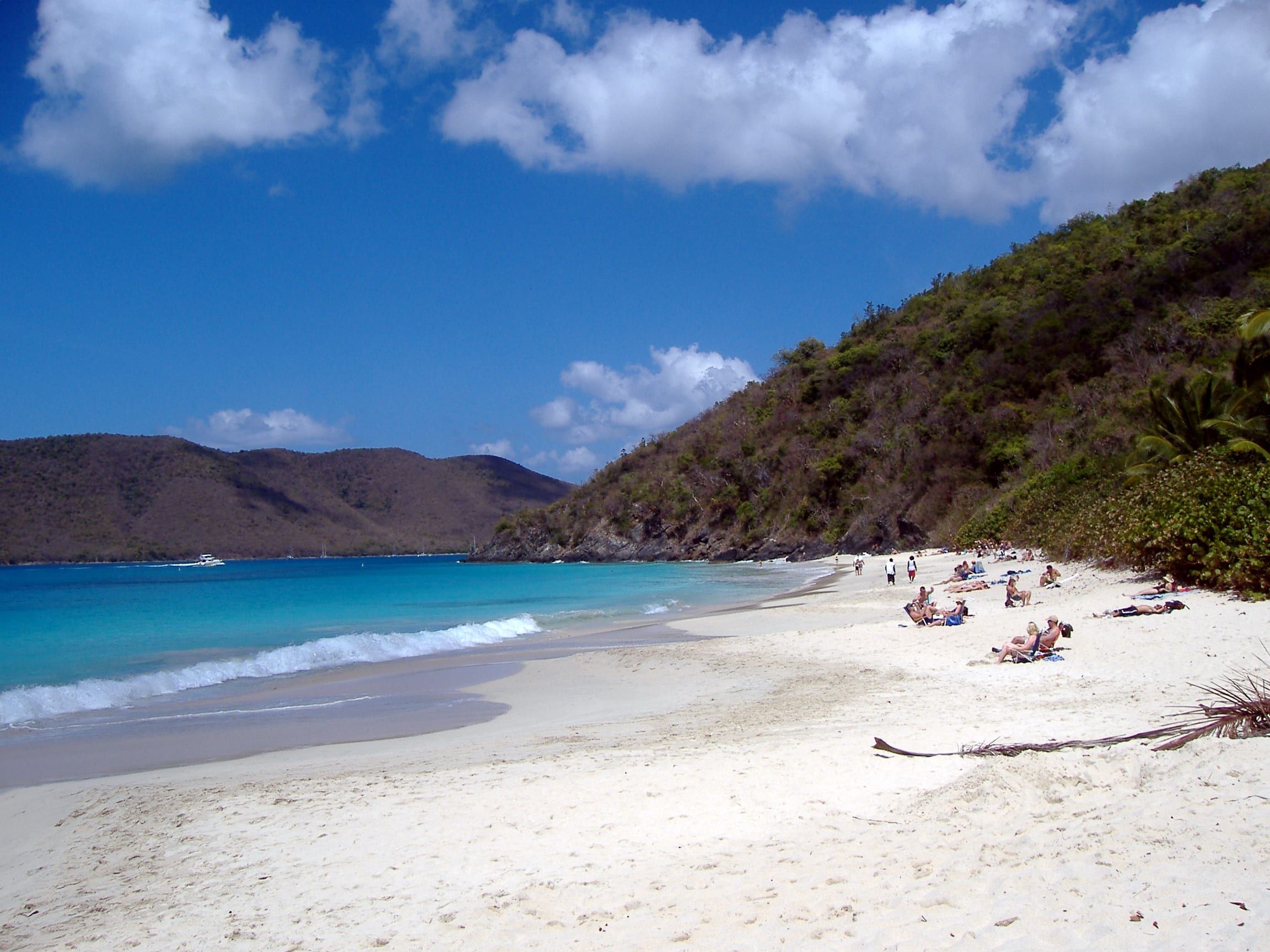
Photo: “Cinnamon Bay” by John Kernan, via Wikimedia Commons, public domain. Cinnamon Bay
BeachNorth Shore
One of the longest beaches in the park, shaded and gently sloping, with rentals, food and showers at the campground behind it.
- Restrooms
- Showers
- Food
- Chair rental
- Snorkel rental
- Shade trees
Cinnamon Bay Nature Loop
TrailNorth Shore
Easy half-mile loop through the Cinnamon Bay sugar ruins and bay rum forest; the first stretch is a wheelchair-friendly boardwalk.
Concordia and other eco stays
Concordia Eco Resort sits on the hill above Salt Pond Bay at the far southeast of the island, about as far from Cruz Bay as you can get. It mixes three kinds of units:
- Villa studios with A/C, a kitchenette and room for 4.
- Eco cabins for up to 5, with ocean-view balconies and showers on filtered rainwater; no A/C.
- Open-air cabanas with three walls, a queen bed, a solar-heated shower and a flushing toilet; no A/C.
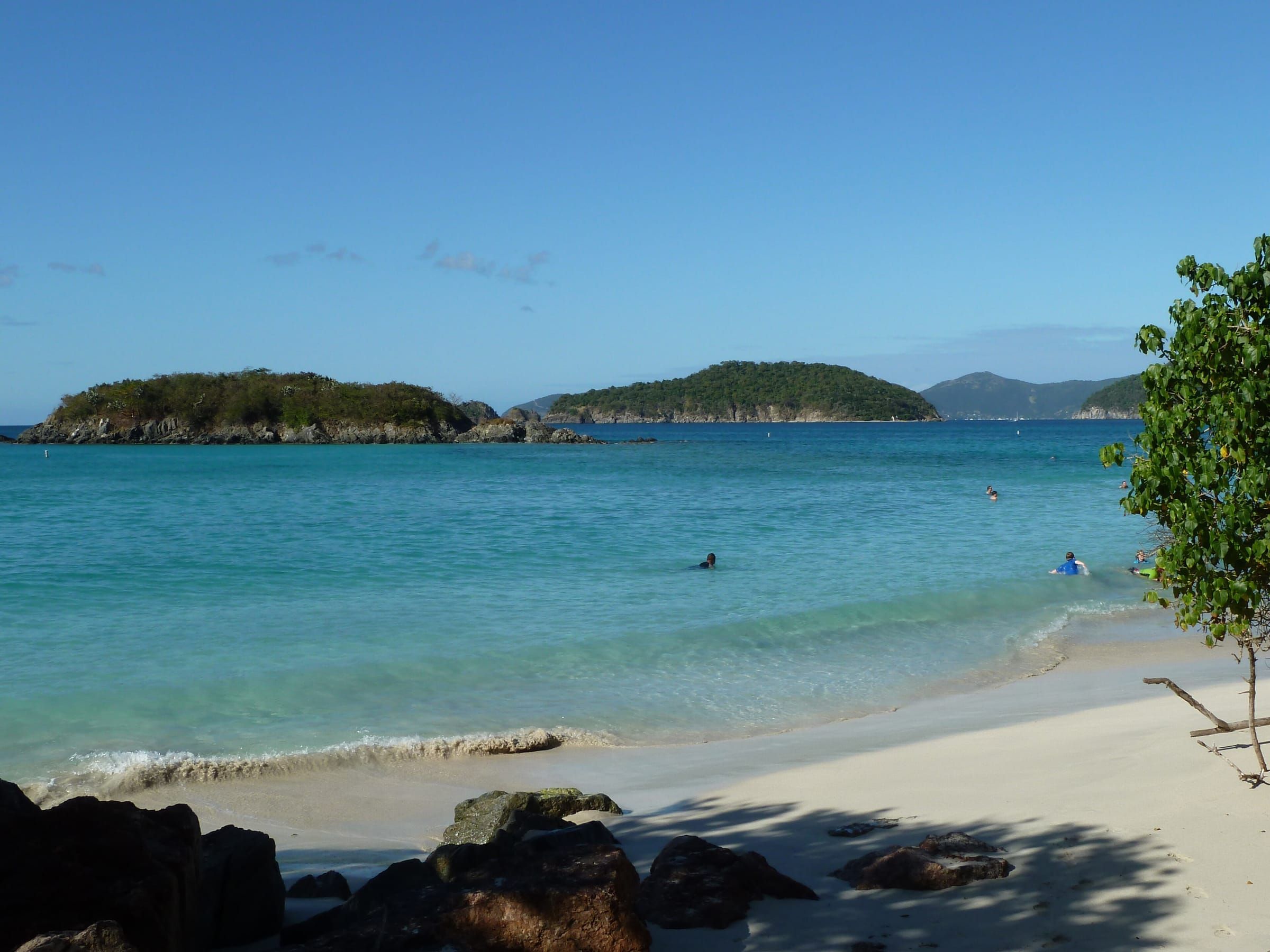
There’s a pool with a sea view. Concordia publishes no rates, and the Book Now link on its home page still carries 2022 dates, so contact the resort by phone or email to book. You’ll need a car (ideally 4WD): it’s a long drive to Cruz Bay, and the nearest food and groceries are in Coral Bay. In return, Salt Pond Bay and the Ram Head trail are a short walk downhill.

Lovango Resort + Beach Club on Lovango Cay rents glamping tents with portable A/C next to its treehouses and villas, open mid-December to mid-July; see Hotels and resorts.
Maho Bay Camps, the tent-cottage camp on the North Shore that many repeat visitors remember, closed in 2013; nothing replaced it, and the shore there is park beach today. Listings that still show it are stale.
What to expect
Camping at Cinnamon Bay is simple and beautiful: you wake up to the beach, but you live with the heat and the island’s infrastructure.
- Heat. Fans only, in eco-tents and cottages alike. If heat bothers you, a cottage with its mini-fridge is the easier stay, and an oceanside unit gets more of the breeze.
- Power. One outlet per tent or cottage and none at bare sites. The camp warns that the island’s power system is volatile and outages are frequent, sometimes lasting overnight or more than a day. Bring a power bank and a battery fan.
- Dark paths. There is no lighting on the paths at night; bring a headlamp.
- No lifeguards. Cinnamon Bay has no lifeguards. Children must be watched at all times on the beach.
- Access. All bathhouses have an accessible toilet-and-shower room, and there are accessible eco-tents and cottages; the Nature Loop has an accessible boardwalk. See Accessible St. John.
- Pack light. The camp asks guests to leave drones, speakers and spray-on sunscreen at home. A sleeping bag is too warm; a sheet and a light blanket are plenty.
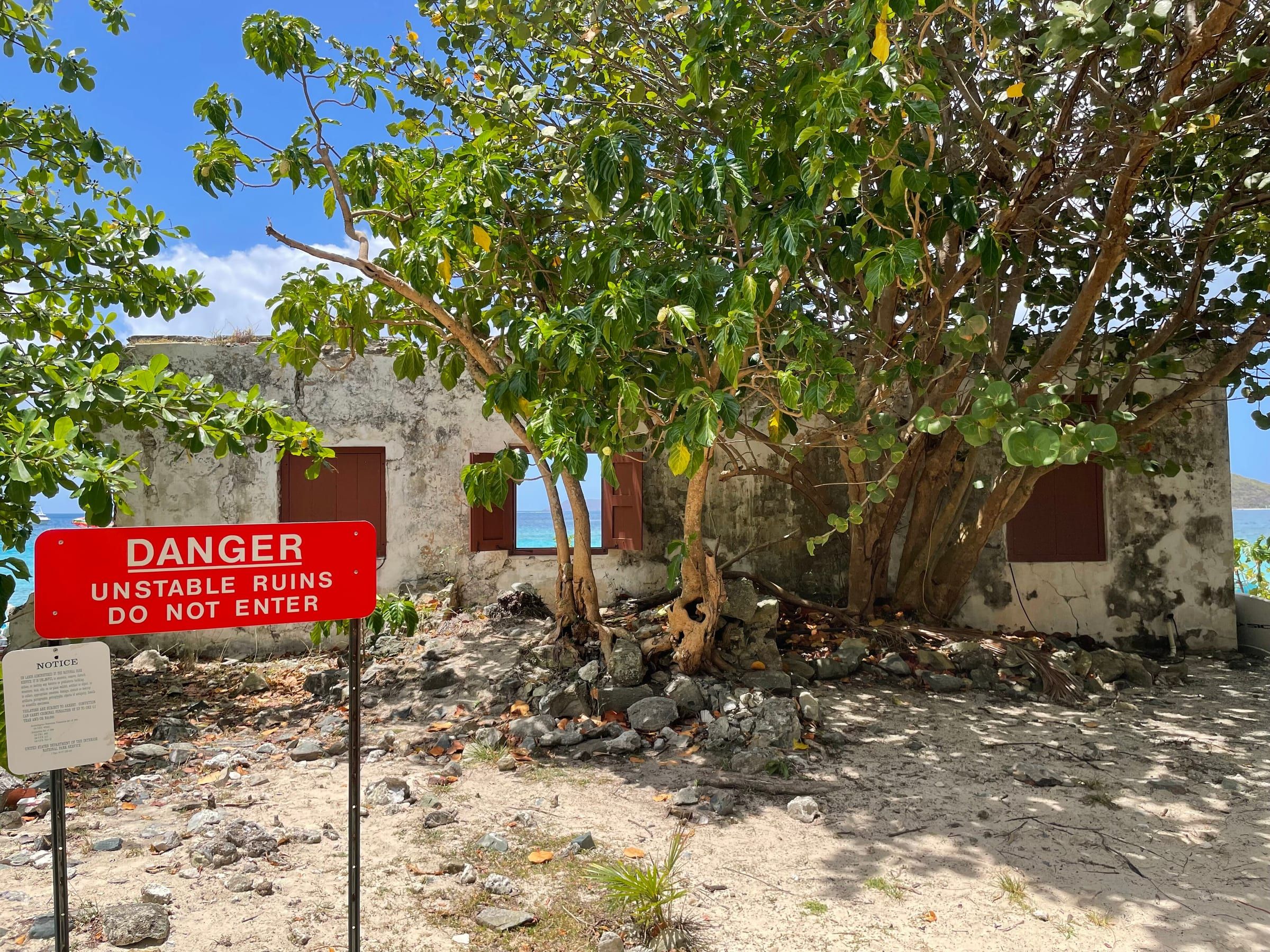

The ruins next to camp are part of the old Cinnamon Bay estate; some are fenced off as unstable, so keep kids out of them.
Bugs and weather
The camp says it plainly: “We 100% guarantee you will see bugs.” Mosquitoes and no-see-ums are worst at dawn and dusk, and the camp’s advice is to leave the beach before “bug thirty” and wear loose, light, long sleeves and pants at night. Bring DEET or picaridin and a fan; moving air keeps no-see-ums off. More in Bugs, no-see-ums and mosquitoes.
Rain comes in short showers most of the year and longer spells in the fall. Bare-site platforms have a rain cover, but bring a dry bag for electronics. Hurricane season runs June to November, and a deposit cancelled inside 30 days is not refunded, so look at travel insurance before you book a fall stay.
What we could not confirm
The campground publishes no 2026–27 season dates and no rates; the November 1 reopening comes from a resident’s closings list, not the camp. Check the booking engine for your dates.